

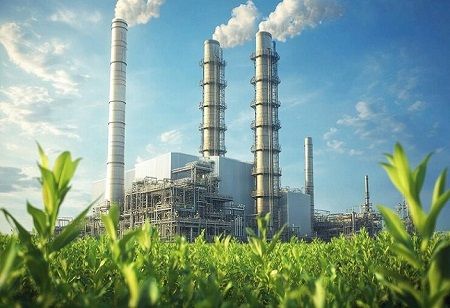
- Singapore boosts energy and chemicals sector for high-value, low-carbon growth.
- Government supports industry with skills, infrastructure, and global links.
- ExxonMobil opens new facility, strengthening long-term partnership.
Singapore will persist in enhancing its industries, including the energy and chemicals (E&C) sector, to attain higher-value, lower-carbon, and more sustainable production, despite a difficult global economic landscape, stated Deputy Prime Minister Gan Kim Yong.
To reach this objective, the Government will collaborate with industry leaders and invest in factors that enhance the Republic's competitiveness – a skilled workforce, top-notch infrastructure, a pro-business climate, and integration into global networks of energy, goods, and talent, said DPM Gan, who is also the Minister for Trade and Industry.
During the inauguration of ExxonMobil's Resid Upgrade Project – aimed at generating premium lubricant base stocks and fuels with reduced sulfur – DPM Gan stated that ExxonMobil is among Singapore's "most important" allies in the E&C industry. The new facility is currently ExxonMobil’s sole plant globally to manufacture the high-quality new lube base stock known as EHC 340 MAX, serving customers in Asia, Europe, and North America.
DPM Gan said, “This occasion marks not only the start of ExxonMobil’s new facility in Singapore, but also an important milestone in the longstanding partnership between Singapore and ExxonMobil, a partnership that has shaped the growth of our energy and chemicals sector.”
Also Read: Iran, Belarus to Boost Cooperation in Farming, Forestry
The E&C industry is a crucial foundation of Singapore’s manufacturing sector, accounting for approximately 25% of the country’s overall manufacturing production. It positions Singapore in the worldwide fuels and chemicals supply chain, while enhancing the nation's role as a maritime and aviation center.
ExxonMobil, having launched its initial refinery in 1966, currently manages a unified refining and petrochemical facility on Jurong Island and has committed over $30 billion in fixed asset investments so far. “This has, in turn, built up production capacity in Singapore; created good jobs, deep and technical capabilities; and nurtured a strong network of suppliers and service providers,” said DPM Gan.