

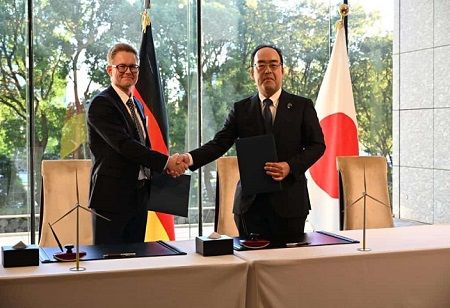
Japan’s industry ministry and Siemens Energy sign an MoU to advance floating offshore wind projects, strengthen supply chains and train specialists, while the company plans an Asia-focused operations hub in Hokkaido.
Japan’s Ministry of Economy, Trade and Industry (METI) has signed a memorandum of understanding (MoU) with German energy technology company Siemens Energy to promote floating offshore wind power and strengthen the country’s renewable energy industry. The agreement, establishes a framework for cooperation on project development, supply-chain expansion and specialist workforce training.
The partnership aims to support the development and commercialisation of floating offshore wind technology in Japan. Unlike conventional offshore wind turbines, which are installed on fixed foundations on the seabed, floating turbines are mounted on platforms anchored in deeper waters. This technology can enable countries with deep coastal waters to access additional offshore wind resources.
Also Read: The Evolving Landscape of India's Offshore Energy Sector
Under the agreement, Japan and Siemens Energy will work together to advance floating wind projects and develop the industrial capabilities required to support the sector. Strengthening supply chains and training skilled workers are key priorities, as Japan seeks to expand domestic expertise and establish a more resilient offshore wind industry.
As part of its wider regional strategy, Siemens Energy plans to establish a wind power operations and maintenance facility in Eniwa, Hokkaido, in January 2027. The facility is expected to serve as the company’s first strategic operations and maintenance hub in Asia, supporting activities across the region, including the Philippines and Vietnam.
The proposed hub is intended to strengthen maintenance capabilities and improve the resilience of offshore wind supply chains. Establishing regional operational support could also help develop technical expertise and improve coordination for wind energy projects across Asian markets.
Japan has identified offshore wind power as an important component of its energy transition and industrial development strategy. The government is working to attract investment, expand domestic manufacturing capabilities and develop the skilled workforce needed to support large-scale renewable energy projects.
Also Read: Quality as the Quintessence: Raising the Bar for ASEAN's Industrial Sector
Floating wind technology is particularly relevant to Japan’s geography, where deep coastal waters can limit the deployment of turbines on fixed foundations. Developing the technology and its supporting supply chain could help the country access additional wind resources while creating opportunities for engineering, equipment manufacturing and maintenance services.
The agreement also aligns with Japan’s broader efforts to reduce dependence on imported energy and strengthen domestic clean energy infrastructure. However, the MoU does not announce a specific wind farm, project capacity or investment amount. Further implementation details are expected to depend on subsequent cooperation and project development.