

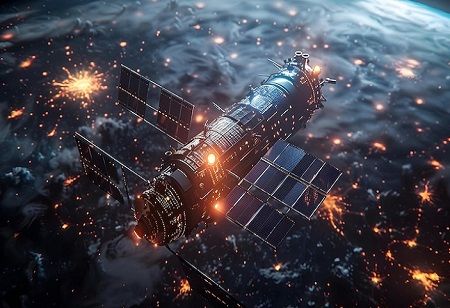
- South Korea integrates AI in space for satellite analysis, autonomous ops.
- Focus on disaster monitoring, swarm coordination, trajectory optimization.
- Govt funding targets AI smallsat constellations by 2030 in $1T market.
South Korea is a prime example of a country that is effectively utilizing artificial intelligence to elevate its space program and thereby gain an advantage over its international rivals. According to a report by Chosun Ilbo, the republic of Korea is implementing AI in diverse areas such as satellite data analysis, the autonomy of spacecraft, and predictive maintenance, thus climbing up the ranks of the space technology leaders to be on par with the U.S. and China.
Some of the characteristically Korean space, tech innovations are AI, powered Earth observation satellites that can detect natural disasters in real time and monitor climate change, and the use of AI to coordinate swarm satellites for better communication and surveillance. Companies such as Hanwha Aerospace and the Korea Aerospace Research Institute (KARI) are the names behind cutting, edge AI algorithms that facilitate the optimization of launch trajectories, the reduction of fuel consumption, and the advent of on, orbit self, repair capabilities.
Also Read: Seoul, London Sign Upgraded FTA Easing Korean Trade
Heavy investments have been made by the government under the National Space Development Plan, with a clear emphasis on AI, powered small satellite constellations by the year 2030. This move is aimed at meeting the demand for low Earth orbit services that have resulted from the emergence of a $1 trillion global space economy by 2040. AI is put forward as the main factor in reducing operational costs by up to 40% and in speeding up data processing from terabytes collected every day.
There are still issues such as the scarcity of skilled personnel and the requirement for international collaboration, but partnerships with global players are helping to extend Korea's footprint. The report positions AI as a major theme that would allow South Korea to make the space industry's next big leap from a hardware, focused to an intelligence, driven one.