
Saudi Arabia plans to store crude oil at Singapore’s Jurong Rock Caverns from the second half of 2027, strengthening regional supply-chain resilience and Singapore’s energy security.
Saudi Arabia plans to begin storing crude oil in Singapore in the second half of 2027 under a proposed arrangement aimed at strengthening its oil supply chain across Southeast Asia and improving Singapore’s energy security. The initiative marks a step towards closer energy cooperation between the two countries amid concerns over disruptions to global oil shipments.
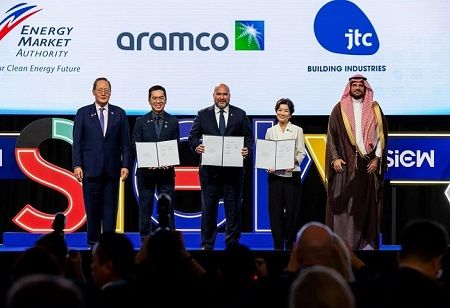
The agreement was announced on October 26, 2026, during Singapore International Energy Week. Singapore’s Energy Market Authority and JTC Corporation exchanged a memorandum of understanding with Saudi Arabian Oil Company, also known as Saudi Aramco, to begin work on the proposed storage arrangement. The energy ministries of both countries will coordinate with the relevant organisations to advance its implementation.
Also Read: Predictive Maintenance: A Game-Changer for Oil and Gas Industry
Under the proposal, Saudi crude oil will be stored at the Jurong Rock Caverns, an underground facility on Singapore’s Jurong Island. The stored oil is expected to help meet Singapore’s energy requirements during supply disruptions, while allowing Saudi Arabia to position crude closer to major Asian markets. The arrangement is intended to improve supply flexibility and strengthen the resilience of regional energy networks.
The Jurong Rock Caverns can accommodate up to 1.47 million cubic metres of liquid hydrocarbons, equivalent to approximately nine million barrels. However, the two countries have not disclosed how much storage capacity will be allocated to Saudi crude or the financial terms of the proposed arrangement. Singapore’s Energy Minister, Tan See Leng, said negotiations were expected to conclude within a few months.
The plan comes as disruptions to energy shipments through the Strait of Hormuz and other regional routes have highlighted the vulnerability of global oil supply chains. Asian economies rely heavily on crude imports from the Middle East, making storage infrastructure and diversified supply arrangements important for managing shortages and price volatility. Keeping crude closer to consuming markets can also help reduce the time needed to respond to supply emergencies.
Saudi Arabia already has an established crude storage arrangement in Japan. In November 2025, Aramco and Japan’s Organization for Metals and Energy Security renewed an agreement covering approximately 8.2 million barrels of storage in Okinawa. The arrangement gives Japan preferential access to the stored crude during emergencies while allowing Aramco to use the location as a supply hub for Asian customers.
Also Read: Achieving Carbon Neutrality: Steps for Sustainable Manufacturing
The proposed Singapore facility would extend Saudi Arabia’s regional storage network and reinforce Singapore’s position as a major energy and trading hub. For both countries, the initiative reflects a broader effort to improve preparedness for supply disruptions through international partnerships, strategic storage and more flexible access to energy resources.