

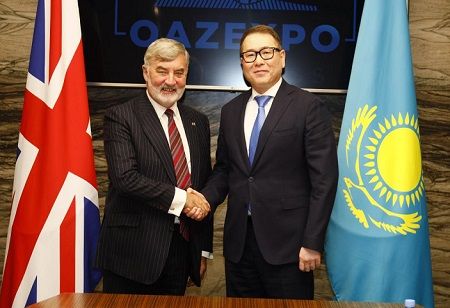
Kazakhstan and the UK seek to expand trade through higher-value exports, mineral processing and investment in manufacturing, energy, logistics and technology, while strengthening standards, research and export cooperation.
Kazakhstan and the United Kingdom are seeking to expand bilateral trade by increasing higher-value exports, developing mineral-processing capabilities and attracting investment across manufacturing, energy, logistics and technology. The discussions come as trade between the two countries continues to grow rapidly.
Kazakhstan’s Minister of Trade and Integration Arman Shakkaliyev discussed the priorities with Lord John Alderdice, the UK Government’s Trade Envoy to Azerbaijan and Central Asia. Their talks covered trade diversification, industrial cooperation, investment, scientific research and education.
Also Read: How AI Becomes the Core Engine of Industry 4.0
Bilateral trade reached $1.63 billion in 2025, an increase of 83.7% from the previous year. During January-July 2026, trade turnover stood at $1.25 billion, up 68.5% compared with the corresponding period in 2025. Despite the growth, Kazakhstan is seeking to broaden the composition of its exports to the British market.
Kazakhstan’s current exports to the UK are mainly composed of silver, crude oil, copper and copper cathodes. Shakkaliyev said the country wants to move beyond raw-material exports and increase shipments of products with greater value addition.
To support this objective, Kazakhstan proposed organising a trade and economic mission for British importers and retail representatives to visit the country and establish direct links with local producers. The discussions also covered British requirements concerning product quality, certification, packaging and standards.
Critical minerals and mineral processing emerged as another important area of cooperation. The UK sees opportunities for British companies, universities and research institutions to work with Kazakhstan on processing activities and the development of higher-value products rather than focusing only on mineral extraction.
The two sides also discussed potential British investment in Kazakhstan’s manufacturing, energy, logistics and high-technology sectors. Cooperation in standardisation and export readiness was considered, including knowledge exchanges involving the UK Institute of Export and International Trade and collaboration between KazStandard and the British Standards Institution.
Also Read: How Industrial AI Transforms Manufacturing
Carbon-related trade requirements, including the European Union’s Carbon Border Adjustment Mechanism, were also discussed. The sides examined cooperation between universities and research institutions in mining, mineral processing and the nuclear industry.
The talks build on the broader Kazakhstan-UK Strategic Partnership and Cooperation Agreement, which provides a framework for cooperation in areas including critical minerals, trade, logistics, education and technology.