

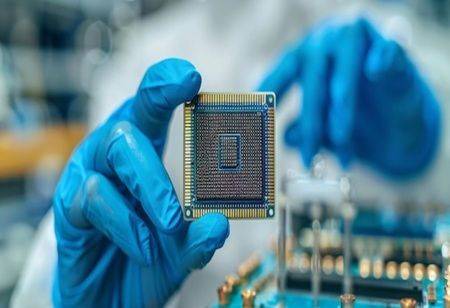
- TSMC begins mass production of 2nm chips, boosting performance and efficiency.
- New 2nm chip technology enables faster speeds with significantly lower energy consumption.
- Industry adoption of 2nm chips will expand smartphone, AI, and HPC markets.
Taiwan Semiconductor Manufacturing Company (TSMC) has officially begun mass production of 2nm chips, marking a major milestone in the global semiconductor industry. TSMC’s 2nm (N2) technology has started volume production in Q4 2025 as planned. This achievement follows years of research and development and places TSMC at the forefront of advanced chip manufacturing.
The 2nm process represents a significant leap forward from the company’s previous 3nm technology, offering improvements in performance, energy efficiency, and transistor density. The N2 node is expected to deliver enhanced capabilities for the next generation of consumer and enterprise devices, supporting a range of applications from smartphones to artificial intelligence (AI) chips and high-performance computing (HPC) processors.
Production of the new chips has begun at TSMC’s Fab 22 facility in Kaohsiung, Taiwan, with additional output expected to ramp up as yields improve. The mass production rollout confirms that TSMC has met its internal roadmap targets, even as demand from major technology customers continues to grow. Its ability to start volume manufacturing on schedule underscores TSMC’s deep expertise in nanosheet transistor technology and advanced semiconductor process engineering.
Also Read: How Industrial AI Transforms Manufacturing
Industry analysts note that the transition to 2nm will have broader implications for the global tech ecosystem. The new chips are designed to help devices run faster and consume less power, an essential advantage as markets shift toward more energy-efficient computing and AI-driven solutions. Furthermore, TSMC’s leadership in this area reinforces Taiwan’s pivotal role in the global supply chain for high-end semiconductors.
TSMC’s latest production milestone also aligns with strong market demand for cutting-edge silicon. Major clients, including leading mobile and AI platform developers, are expected to leverage the 2nm node in their next-generation products, driving adoption across consumer and server markets. Because of these advancements, the semiconductor industry anticipates broader commercial deployment of 2nm chips in devices launching over the next year and beyond.