

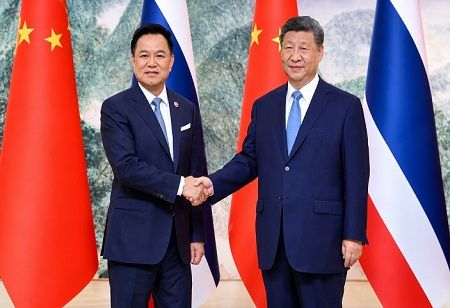
Thailand and China agree to strengthen cooperation on cross-border water pollution, promote trade in 500,000 tonnes of Thai rice, attract investment in advanced industries and accelerate regional railway connectivity.
Thailand and China have agreed to strengthen cooperation on cross-border water pollution, trade, investment and regional connectivity following talks between Thai Prime Minister Anutin Charnvirakul and Chinese President Xi Jinping on November 20, 2026, on the sidelines of the 33rd Asia-Pacific Economic Cooperation (APEC) Economic Leaders' Meeting in Shenzhen, China.
A key focus of the discussions was toxic contamination in rivers and its impact on the environment, agriculture and communities. Anutin stressed the need for coordinated action to address transboundary water pollution, while Xi expressed China's readiness to provide technical support for water-quality monitoring, investigations and remedial measures.
Also Read: How Renewable Energy is Reshaping Manufacturing Landscapes
The two countries will work towards a more systematic approach to identifying and addressing contamination through expanded water-quality checks, closer monitoring and technical cooperation. Anutin also proposed placing the issue on the agenda of the Mekong-Lancang Cooperation (MLC) Leaders' Meeting scheduled for December in Guilin, China.
Economic cooperation featured prominently in the discussions, with both sides agreeing to encourage high-quality Chinese investments in Thailand through a joint value-creation approach. Priority sectors include digital technology, clean energy, space technology and electric vehicles (EVs). The initiative aims to strengthen industrial partnerships and support technology development.
The leaders also agreed to promote balanced bilateral trade by expanding market access for Thai products through geographical indication registration and online platforms. They specifically discussed facilitating trade in 500,000 tonnes of Thai rice, creating additional opportunities for agricultural exporters.
Regional infrastructure connectivity was another priority. Both countries agreed to accelerate railway development linking China through Laos and Thailand to Malaysia and Singapore. Projects include a second railway bridge between Nong Khai in Thailand and Vientiane in Laos, as well as the Chiang Khong-Nateuy-Mohan route.
Security cooperation was also discussed, particularly joint efforts to combat transnational crime and online scam networks. Thailand reaffirmed its commitment to improving tourist safety and strengthening information sharing to restore confidence among international visitors.
Also Read: The Impact of Trade Wars: Risks and Opportunities for Asian Manufacturers
The discussions further covered safe and accessible artificial intelligence cooperation, regional peace and stability, biodiversity conservation and developments in Myanmar and Cambodia. Both leaders reaffirmed their commitment to strengthening the comprehensive strategic cooperative partnership and translating bilateral discussions into practical initiatives.