

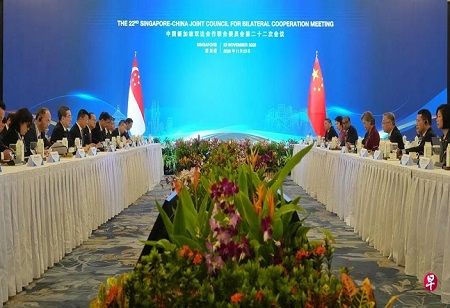
Singapore and China announce 29 cooperation outcomes covering digital trade, finance, healthcare, research, agriculture and industrial development at their 22nd JCBC meeting.
Singapore and China have announced 29 cooperation outcomes across trade, finance, science and technology, public health, digitalisation and industrial development at the 22nd Joint Council for Bilateral Cooperation (JCBC) meeting held in Singapore on November 23, 2026. The meeting was co-chaired by Singapore Deputy Prime Minister Gan Kim Yong and Chinese Vice-Premier Ding Xuexiang, who reviewed progress in bilateral relations and discussed new areas for economic and strategic collaboration. The outcomes include new agreements, renewed memoranda of understanding (MoUs) and initiatives to strengthen business and institutional partnerships.
Also Read: Beyond Cost: Considerations for Shifting Production to Southeast Asia
Trade cooperation featured prominently, with both countries renewing an MoU to deepen collaboration in services. The agreement is expected to create opportunities for companies to establish partnerships and expand access to services in healthcare, eldercare, professional and legal services, tourism and sustainability. The two sides also signed an MoU on digital trade involving Singapore's Ministry of Energy and Trade, China's Ministry of Commerce and the Chongqing Municipal Government. The initiative aims to improve digital trade connectivity, including through electronic documentation and cross-border recognition of trade documents.
Financial connectivity was another major focus. Singapore's Monetary Authority and the People's Bank of China are exploring a linkage between their fast payment systems to facilitate small-value cross-border transfers. The countries also agreed to strengthen renminbi cooperation, capital market connectivity and collaboration between financial institutions. These initiatives aim to support trade financing, investment flows and business access to each other's markets.
The cooperation outcomes also cover scientific research, healthcare, agriculture and environmental sustainability. Agreements include collaboration on forensic science research, public health and communicable diseases, agricultural science and technology, and regulatory cooperation on health products. Singapore and China will also establish research partnerships involving institutions in infectious diseases, biotechnology and cancer research. In food security, Singapore approved China's Hainan Province for exports of frozen and chilled poultry, pork and poultry eggs, broadening its food supply options.
Also Read: Balancing Labor Costs and Quality in Asia's Manufacturing Industry
Industrial development and regional connectivity also feature in the outcomes. Initiatives include cooperation on smart customs, digital and intelligent industrial development, and an economic corridor connecting the Beijing-Tianjin-Hebei region with Southeast Asia through Singapore. The Singapore National Olympic Council and Chinese Olympic Committee also signed an MoU to strengthen sporting exchanges.
The agreements build on the countries' existing government-to-government projects and reflect their efforts to expand practical cooperation across traditional and emerging sectors.