

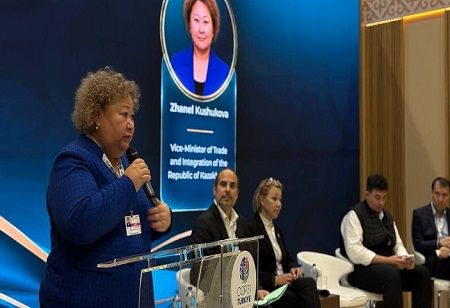
Kazakhstan plans to develop the Middle Corridor into a greener Asia-Europe trade route through railway upgrades, digital logistics, higher freight capacity and environmental standards to improve connectivity and reduce transport emissions.
Kazakhstan is seeking to strengthen the Trans-Caspian International Transport Route (TITR), known as the Middle Corridor, as a sustainable trade link connecting Asia and Europe. The country plans to increase freight volumes, digitalise logistics operations and introduce environmental standards to improve the route's efficiency and competitiveness.
The Middle Corridor connects China and Central Asia with Europe through Kazakhstan, the Caspian Sea, Azerbaijan, Georgia and Türkiye. It provides an alternative to traditional east-west transport routes and is gaining importance as countries seek to diversify supply chains and improve regional connectivity.
Also Read: How Industrial AI Transforms Manufacturing
Kazakhstan's strategy focuses on upgrading railway infrastructure, expanding port capacity and improving multimodal transport services. Digitalising customs procedures and logistics operations is also a priority, as better coordination between transport operators and border authorities can reduce delays and improve the movement of goods across multiple countries.
The country's green transport ambitions include encouraging a shift from road freight to rail, which can reduce transport-related emissions. Investments in modern railway infrastructure are expected to support this transition while improving the corridor's capacity and resilience. Environmental standards are also expected to play a role in positioning the route as a more sustainable option for international trade.
The World Bank is supporting Kazakhstan's railway connectivity programme through an $846 million guarantee designed to mobilise $1.41 billion in long-term commercial financing. The project aims to modernise the country's rail network, strengthen logistics infrastructure and improve the efficiency of the Middle Corridor. It is expected to help triple freight operations and halve end-to-end transit times along the route by 2030.
Kazakhstan is also working with regional partners to improve infrastructure connectivity, harmonise cross-border transport procedures and develop digital platforms for multimodal freight operations. During a meeting in Beijing in September 2026, officials from Kazakhstan and China reaffirmed their commitment to increasing the route's capacity and efficiency.
Also Read: Quality as the Quintessence: Raising the Bar for ASEAN's Industrial Sector
The World Bank estimates that strategic investments and coordinated reforms across the Trans-Caspian corridor could more than triple trade volumes, halve travel times and create two million additional jobs by 2040.
Through infrastructure modernisation, digital integration and lower-emission transport, Kazakhstan aims to expand the Middle Corridor's role in international trade while strengthening its position as a Eurasian logistics hub.