

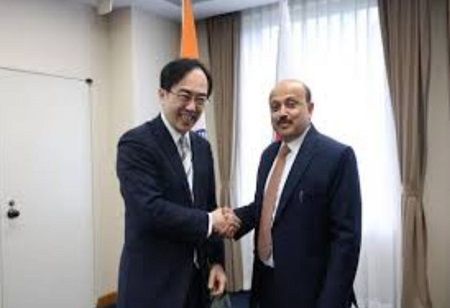
- The India–Japan CEPA joint committee meeting in Tokyo, co-chaired by Rajesh Agrawal, reviewed trade and investment progress
- Discussions highlighted complementary strengths Japan’s technology and India’s skilled workforce
- Agrawal stressed that CEPA provides tariff certainty and regulatory predictability
The seventh joint committee meeting under the India-Japan Comprehensive Economic Partnership Agreement (CEPA) was held in Tokyo earlier this week, aiming to further diversify and strengthen bilateral trade and investment.
The India Japan CEPA review highlights progress under the India Japan trade agreement and strengthens the India Japan investment partnership, focusing on effective CEPA implementation India Japan, enhanced bilateral trade cooperation India Japan, and broader goals of the economic partnership agreement.
The meeting was co-chaired by Rajesh Agrawal, Secretary of India’s Department of Commerce, and the Senior Deputy Minister of Japan’s Ministry of Foreign Affairs.
The officials from both nations examined CEPA implementation progress while they searched for ways to improve economic collaboration between their countries. The main discussions concentrated on two topics, which included expanding trade and investment relationships and solving implementation problems that the agreement faced.
On the sidelines, Agrawal also met the Vice Minister of the Ministry of Economy, Trade and Industry (METI) to discuss bilateral trade, investment, improving the business environment, and preparations for the upcoming 14th Ministerial Conference of the World Trade Organization.
Also Read: India-Japan Strengthen Cooperative Development Framework
The August 2025 annual summit between India and Japan established shared goals, which Agrawal used to demonstrate how Japan and India complement each other through their respective economic strengths, which include Japan's advanced technology, manufacturing abilities, India's skilled workforce, domestic market and growing economic power.
The Indian export market to Japan contains high potential, which covers textiles, pharmaceuticals, agricultural products and services; although he emphasized that balanced trade relationships should be developed because they provide essential support for sustainable economic development.
Agrawal discussed CEPA advantages with Japanese industry representatives during a roundtable meeting, which showed that CEPA delivers both tariff stability and predictable regulatory conditions.
The agreement creates a stable relationship which enables India and Japan to work together as remote partners for international value and supply chain activities while their bilateral trade and investment operations continue to develop and diversify.