

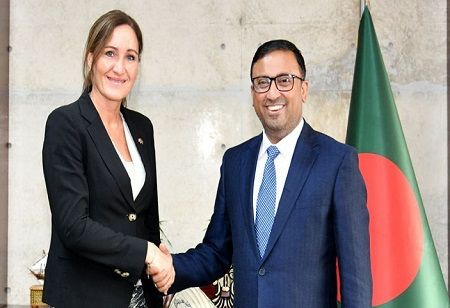
Bangladesh and Denmark agree to strengthen trade, investment and green cooperation, advance a proposed trade committee and support Bangladesh-EU FTA discussions during bilateral consultations in Dhaka.
Bangladesh and Denmark have agreed to strengthen bilateral economic cooperation, with discussions covering trade, investment, renewable energy, infrastructure and the proposed free trade agreement (FTA) between Bangladesh and the European Union. The developments emerged during the fourth round of political consultations between the two countries, held in Dhaka.
The consultations were co-chaired by Md Nazrul Islam, Secretary (East-West) of Bangladesh's Ministry of Foreign Affairs, and Elsebeth Søndergaard Krone, Denmark's State Secretary for International Partnerships. Both sides reviewed progress since their third round of consultations in May 2025 and discussed opportunities to expand cooperation across several economic and development sectors.
Also Read: Why Ongoing Innovation is more Critical in the Retail industry
Trade and investment emerged as important priorities in the discussions. The two governments agreed to advance a proposal to establish a Bangladesh-Denmark Trade and Investment Committee in consultation with relevant stakeholders. The proposed committee will bring together authorities from both countries to promote commercial opportunities, address business-related barriers and strengthen investment engagement.
Denmark also expressed support for Bangladesh's ongoing exploratory initiatives with the European Union towards negotiating a proposed FTA. Bangladesh highlighted the importance of predictable and long-term market access to support its export industries and facilitate a smooth transition following its graduation from the least developed country category.
The two countries also discussed cooperation in climate adaptation, renewable energy, energy efficiency, water management, circular economy, sustainable agriculture, maritime affairs and education. Migration management and skills development were additional areas of focus, particularly the development of safe and regular migration pathways.
The consultations also resulted in the signing of a renewed government-to-government memorandum of understanding on public-private partnership cooperation, following the expiry of the previous five-year agreement. Both sides welcomed the Agreement on Implementation of Component II of the Saidabad Water Treatment Plant Phase III, involving a revised procurement strategy for the DKK 2.4 billion (approximately €300 million) project supported by Impact Fund Denmark. The initiative aims to improve access to safe drinking water in Dhaka.
Another agreement was signed between the Asian University for Women and APM Terminals to strengthen cooperation between education and industry. The partnership will support internships, employment opportunities and maritime education for women in Bangladesh.
Also Read: Advanced Materials: Next-Gen Protection for Land, Sea & Air Ops
Both governments reaffirmed their commitment to democracy, human rights, good governance and the rule of law. They also agreed to begin a process in 2027 to define a framework for bilateral cooperation beyond 2028, reflecting the growing importance of trade, investment and sustainable development in their relationship.