

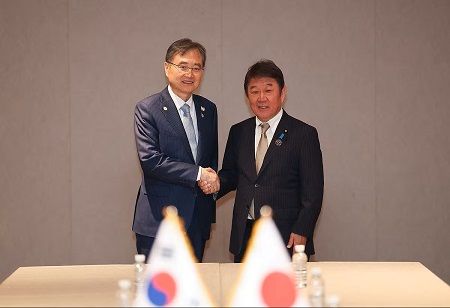
- Toshimitsu Motegi and Cho Hyun agreed to ensure safe navigation in Strait of Hormuz region.
- Both nations emphasized importance of stable energy supplies amid Middle East tensions affecting oil transportation routes.
- Ministers pledged continued communication and strengthened bilateral cooperation to address regional security and economic challenges.
The two leaders have restated their dedication to maritime security protection and safe navigation assurance in the vital Strait of Hormuz area.
The two officials spent 20 minutes on a phone call to examine Middle Eastern developments and to assess how these developments affected worldwide energy distribution and essential goods movement.
The two nations established that their economic security needs required them to maintain stable conditions in the Strait of Hormuz because it serves as a vital oil shipping route which connects both Japan and South Korea to their energy sources.
South Korea depends on Middle Eastern countries for almost 70 percent of its crude oil supplies which makes the country vulnerable to disruptions that occur in that region just like Japan.
The ministers acknowledged that the effective blockade of the strait has heightened concerns about supply chain stability and energy security.
Also read: AI, Cyber Deals Drive $1.2B For Israeli Startups
They established a system for ongoing contact which would enable them to observe progress while deciding when to take action. The two countries need to work together because their shared geopolitical and economic problems require their joint efforts to achieve solutions.
The two officials evaluated the current state of their diplomatic relations while they discussed matters related regional security.
The officials showed proof of their success when they mentioned Lee Jae-myung's visit to Japan's Nara Prefecture, which he conducted earlier this year to meet with Sanae Takaichi.
The two parties confirmed their intention to maintain their "shuttle diplomacy" program, which requires leaders to engage in regular reciprocal visits, as a method to establish stable relations between the two nations.
The two parties involved in the discussions showed a common commitment to enhance their collaboration in both security operations and diplomatic activities.